
The psychological development of dogs
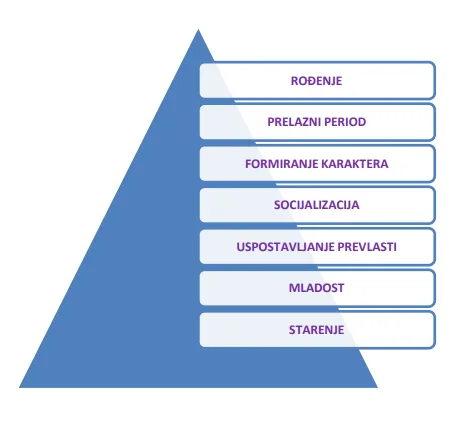
The neonatal period (weeks 1 to 2 of a puppy's life): the puppy mostly rests. The transitional period (week 3 of a puppy's life): the senses of sight and hearing begin to develop and the puppy is more active. The character-forming period (weeks 4 to 7 of a puppy's life): during this period the puppy's brain has developed enough and become

The neonatal period ( weeks 1 to 2 of a puppy's life ): the puppy mostly rests.
The transitional period ( week 3 of a puppy's life ): the senses of sight and hearing begin to develop and the puppy is more active. The character-forming period ( weeks 4 to 7 of a puppy's life): during this period the puppy's brain has developed enough and become capable of learning. Everything the dog learns in its pack during this phase will feel familiar to it later.
If the character-forming process goes wrong or is not worked on at all, it can later have profound consequences for the dog's relationship with its community.
The socialisation period (weeks 8 to 12 of a puppy's life) involves learning how the puppy can approach its community in the right way.
This period is ideal for separating the puppy from its litter. The puppy is very curious at this stage, so the most important thing is to teach the owner how to be the leader.
The puppy needs to be given as much contact as possible with people, including children, because some dogs turn out to be afraid of children, run away from them or avoid them, and even attack them. It has to be admitted that a great many dogs said to be distrustful, or to attack and bite in panic, owe their maladjusted behaviour to an owner who did not give them enough contact with people and children during this phase. From the earliest days, as soon as a dog
appears in your life, the process of socialisation begins. Do not fall for the misconception that a dog is too young for training.
Such irresponsibility towards your own dog in terms of socialisation and creating good habits can be seen as an opportunity that nature has given the owner, one that can be lost forever.
When someone asks me: "When is the best time to start training?", I answer: "As soon as it leaves the litter", assuming the puppy left the litter at 10 to 12 weeks. The puppy is ready to learn at that point, and everything it experiences from then on in its life is deeply engraved in its brain.
So in this phase it is very important for the owner to focus on introducing the puppy to the people, children, animals, objects and sounds it will meet in everyday life. The dog needs to be taken out often so that it meets people of different ages and occupations, as well as well-behaved dogs.
The dog should be accustomed to: the noise of the city centre, car journeys, walking on different surfaces, passing cyclists, people in wheelchairs… and all of this should be done with the dog on a lead.
The dominance period (weeks 13 to 16 of a puppy's life) is the period when the dog shows the first signs of dominance and struggles for supremacy, both with other dogs and with the human, its owner. That is why it is so important to teach the dog correct behaviour during the adaptation and socialisation phase.
A dog is a very possessive creature, and this is most noticeable in its attitude to food, toys, living space… When it comes to food, the dog will try to position itself against its owner as an adversary, which can lead to unpleasant situations, even a fight. Example: a dog will growl a warning at an owner who approaches its food bowl while it is eating, or over other things, such as toys, which are guarded as a kind of prey, or on a walk, when the dog wants to go its own way. In this way, through ignorance, the owner allows the dog to establish an equal position with the members of the family.
Because of this mistake, injuries are not uncommon. A young dog should never be given too much freedom, and it is never too early for training, but the training must be suited to the dog's age. Bad habits are hard to correct, since the dog cannot understand why they are suddenly unacceptable, and for that reason it is crucial
that the owner is educated in time about training sessions with their dog, but also about living with it in general.
The juvenile period (months 5 and 6 of life) is the period when loyalty to the leader is already developed. During this period the leader must be psychologically superior, because most dogs do not want to submit. We call this period canine puberty. With the onset of sexual maturity, aggression may appear, so it is important that in this period all members of the family take on the role of leader. It is also characteristic of this period that dogs are inclined to destroy the garden or furniture. The puberty phase ends with the sudden onset of fertility in the dog.
The ageing period is the phase when the dog, with the passing years, becomes less lively, its play instinct and physical strength decline, its senses no longer function as they used to, and the dog sometimes becomes stubborn and moody.
mydogserbia@gmail.com
+381 64 544 7778
SERBIA-ČAČAK
Humane dog trainer Slaven Stevelić
Comments
No comments yet. Be the first.