
Fear in dogs: a study of 43,000 dogs shows how common it is
A US study of more than 43,000 dogs suggests most dogs show at least mild fear in some everyday situation. Here is what that means for you and your dog.
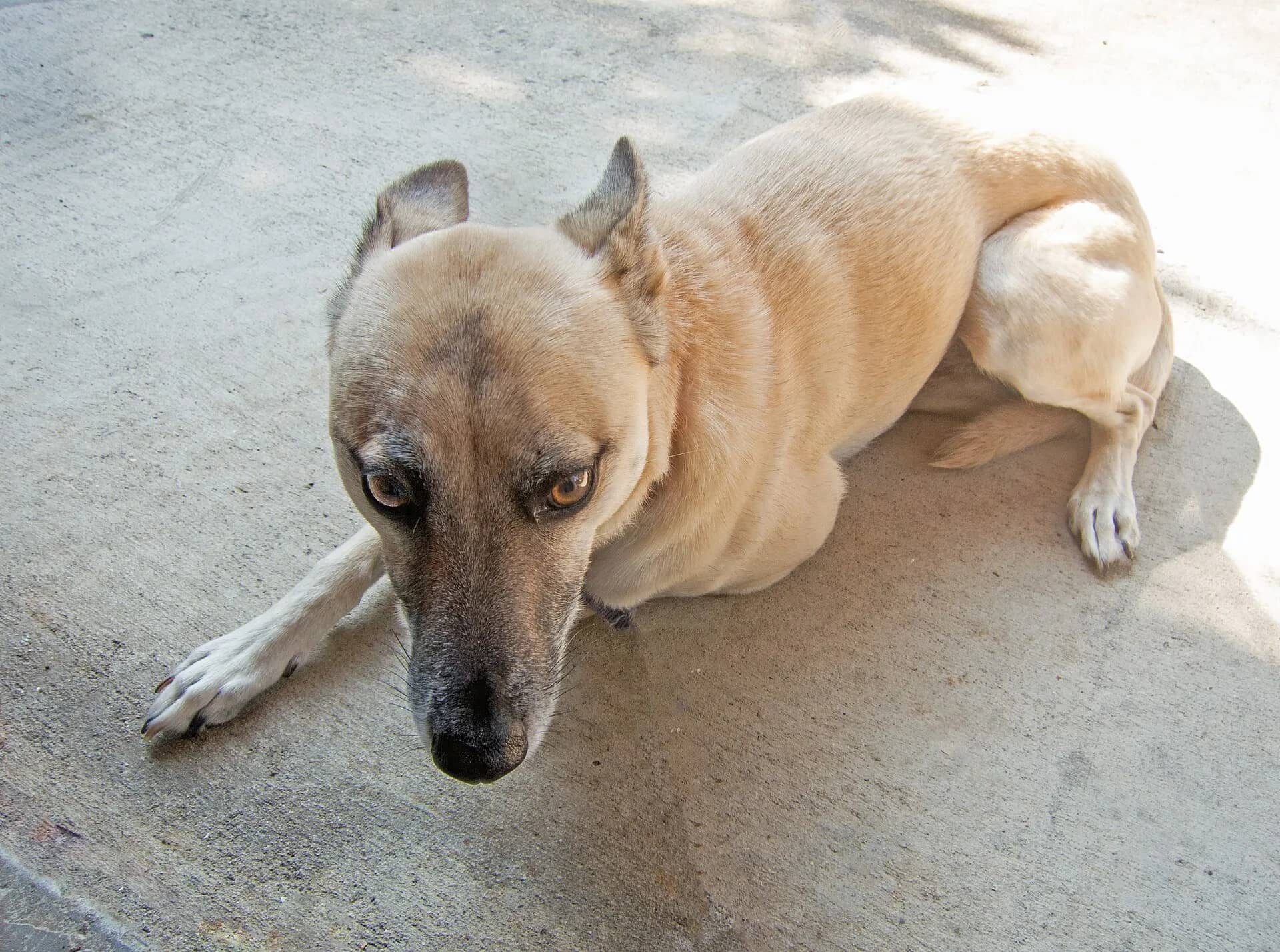
If your dog trembles at thunder, hides behind your legs when a strange dog appears or squirms through every nail trim, you are in good company. A new analysis of more than 43,000 American dogs shows that fear in dogs is far more common than most owners would guess: the large majority of dogs show at least mild signs of fear or unease in some everyday situation. The study comes from Dr. Bonnie Beaver, a professor of animal behavior at Texas A&M University, and uses data from the Dog Aging Project, the largest study of canine health and aging in the United States.
What was actually measured
The paper appeared in April 2026 in Veterinary Research Communications. It covers 43,517 dogs whose owners answered nine questions from the C-BARQ, a standard behavior questionnaire, in 2022. For each situation the owner rated the dog's fear on a scale from 0 (none) to 4 (extreme). The questions covered unfamiliar people, unfamiliar dogs, sudden noises, new objects and situations, plus bathing and nail trimming.
The headline result: 91 percent of dogs had at least one rating of 2 or higher. Leave out bathing and nails, which the author treats as learned fears, and the figure is 84 percent. Almost 60 percent of those dogs were fearful in more than one situation. At the other end, fewer than 3 percent of dogs were extremely fearful across the board.
The most common triggers of fear in dogs
- Unfamiliar dogs: about 47 percent of dogs showed fear in at least one situation involving other dogs, especially when barked at, growled at or lunged at.
- Noise: 42.9 percent were afraid of sudden or loud sounds, and almost one in ten reacted with extreme fear.
- Grooming: nail trims worried about 35 percent of dogs, baths about 22 percent.
- Unfamiliar people: about 22 percent.
"These are behaviors most owners have seen at some point," Beaver says. "What this research shows is just how common those responses are, and how important it is that we pay attention to them."
Does this mean most dogs are anxious?
No. Beaver is careful to point out that the data are owner reports, not clinical diagnoses, and that the study cannot say which dogs need treatment. Short bursts of fear are a normal part of life for dogs, just as for people. The trouble starts when fear lasts, grows stronger or keeps being triggered without any support. That is when it can tip into aggression, and long-term stress is linked to weaker immunity and a poorer quality of life.
It also helps to know how sensitive these numbers are to the way they are counted. An earlier 2024 study by the same author claimed that more than 99 percent of US dogs had at least one behavior problem. James Serpell and Lauren Powell of the University of Pennsylvania reanalyzed the same dataset and concluded those rates were overstated: grouping the questions differently, they found fear in 14.1 to 28.2 percent of dogs, and lower still with a stricter cutoff. The lesson is not that fear is rare, but that "a little fear" and "a behavior problem" are not the same thing.
Beaver also notes that behavior rarely comes up at the vet: "Behavior is an area that often doesn't come up unless the owner brings it up first." Severe storm fear, she adds, is a warning case: "Once it reaches that level, it is almost impossible to manage." The goal is to spot fear early, keep an eye on it and deal with it before it escalates.
What it means for dog owners in Serbia
The triggers at the top of the list are familiar here too. In Serbian cities dogs pass other dogs on every walk, including off-leash and stray dogs, and New Year fireworks and firecrackers are a hard time for many pets every winter. A few practical points:
- Don't force your dog to "get used to it". Repeated exposure without support, such as pulling a dog toward a strange dog or person, can make fear worse rather than better.
- Keep your distance. If your dog freezes or backs away at the sight of another dog, cross the street and reward calm watching from a distance where the dog feels safe.
- Train nail trims and baths in small steps. Learned fears can be unlearned: brief paw handling, a treat, and only later the clippers.
- Prepare for noise before the holidays. Sound fear is hardest to treat once it is severe, so start well before December 31.
- Watch for change. If fear lasts longer or gets more intense, talk to your vet; an experienced trainer can also help with the behavior side.
The bottom line
This study does not say that dogs are broken or that they all suffer from anxiety. It says fear is normal and common, and worth noticing while it is still mild. An owner who recognizes the early signs (ears back, tail tucked, head turned away, a stiff body) is in a much better position to help than one who only reacts once fear has turned into growling or biting.
Sources: Texas A&M VMBS, press release on the dog fear and anxiety study (English), Veterinary Research Communications, Owner-reported prevalence and severity of fear and anxiety in dogs (English), Futurity, More than 84% of dogs show signs of fear or anxiety (English), dvm360, on the University of Pennsylvania reanalysis (English)
Photo: Ellen Levy Finch, CC BY-SA 4.0, Wikimedia Commons
From the shop
Products related to this topic.
 Husse
 Husse
 %Digital
Comments
No comments yet. Be the first.