
How dogs hear speech: their brains track consonants, as ours do
Hungarian scientists have shown that dogs pick out word-like units in continuous speech by relying on consonants, just as people do. What that means for the cues we give our dogs.

When we talk, we don't pause between words. Speech is a continuous stream of sound, and the listener has to work out where one word ends and the next begins. Babies learn this gradually, and it now turns out dogs do something similar. A study by a team at Eötvös Loránd University (ELTE) in Budapest, published in September 2026 in Science, sheds light on how dogs hear speech: like people, they lean mainly on consonants.
An experiment without a single real word
Researchers led by Boglárka Morvai recorded the brain activity of 20 adult dogs and 20 adult humans using scalp electrodes (EEG). Everyone listened to continuous recordings of invented three-syllable words with no pauses at all. There were three kinds of recording:
- in one, the "words" were defined by recurring consonants;
- in another, by recurring vowels;
- in the third, the syllables were scrambled so there was no pattern.
There were no familiar words, so the dogs could not rely on meaning, only on sound patterns.
What the dogs' brains showed
When the "words" were built from consonants, the dogs' brain signals locked onto the rhythm of the three-syllable units. In other words, the dogs were tracking the recurring chunks. With vowel-based "words", the dogs showed no stronger response than with scrambled syllables. Humans, unlike the dogs, picked up the vowel patterns too.
That is striking, because vowels are louder and carry more acoustic energy. So the dogs were not simply following the loudest sounds; they homed in on consonants, just as people do. In human infants, the authors note, the shift from relying on vowels to tracking consonants happens at about 12 months of age.
"What made the result especially interesting was that this bias had not previously been demonstrated in other species," Boglárka Morvai and Dorottya Rácz told ScienceAlert.
Learned rather than inborn?
Of the 20 dogs, 11 had lived in a talkative home before 12 weeks of age, while 9 arrived later, after life on the street or in a shelter. Both groups showed the same consonant bias. The authors therefore think the ability does not require a brain specially wired for language, and that general learning from the patterns a dog hears may be enough. It remains open whether the bias comes from exposure to speech, from domestication or from an older hearing mechanism shared by mammals. Comparing dogs with wolves could be a next step.
There are clear differences from humans as well. "For us, each speech sound is a separate unit, whereas for dogs, syllables form the smallest units of processing," the researchers explain. And the study measures pattern detection, not understanding: it does not show that the dogs learned what the invented words meant.
How dogs hear speech and what it means for training
The study does not hand out training recipes, but together with earlier work by the same group it suggests some sensible lessons. Earlier research indicates dogs can tell individual sounds apart but may pay less attention to small sound changes in words they already know. From a trainer's point of view, it therefore makes sense to:
- Choose cues that differ clearly in syllables and consonants. Words that sound almost the same are easy to confuse.
- Be consistent. If you say "down" one day and "lie down" or "get down" the next, your dog hears different sound patterns for the same thing.
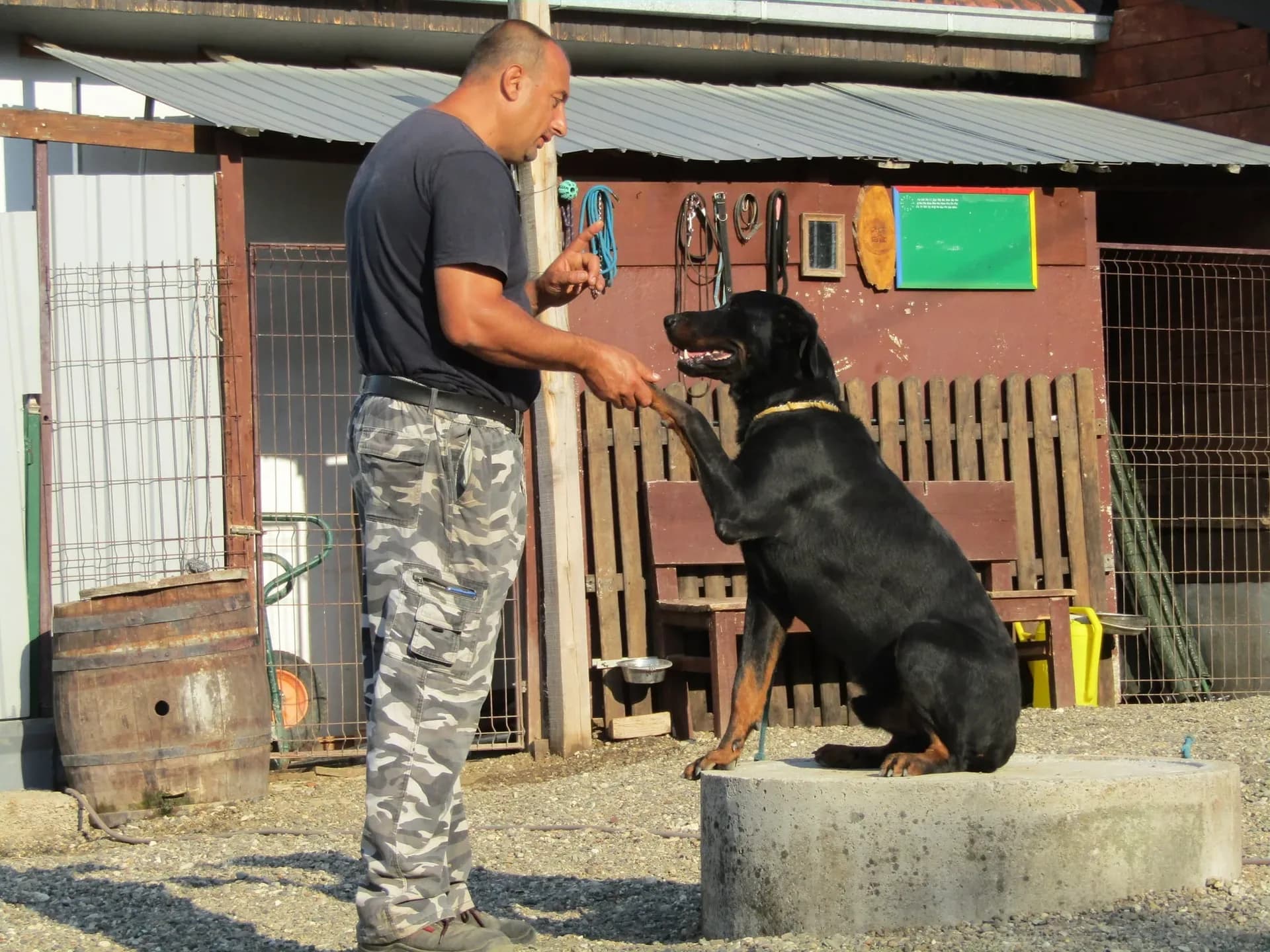
- Don't expect your dog to follow sentences. Dogs track patterns and rhythm, and they learn meaning by linking a word to what happens next, such as a reward.
- Remember that a shelter dog can learn too. Dogs that did not spend their first weeks in a family showed the same basic ability.
What it means for dog owners in Serbia
Short Serbian cues such as "sedi" (sit), "lezi" (down), "mesto" (place), "ostani" (stay) and "dođi" (come) are the norm here. It is worth checking whether two of the cues you use sound too alike, and whether everyone in the household says the same word the same way. Many dogs adopted from Serbian shelters join new families as adults, and this study is good news for them: the ability to pull patterns out of speech does not depend on where they spent their first weeks. With patience, clear words and rewards, such a dog can learn to "read" your speech too.
Sources: ScienceAlert, Dogs Share a Speech Trick Once Thought Uniquely Human (English), Neuroscience News, on the study in Science (English), Techno-Science, Dogs segment our speech as we do ourselves (English)
Photo: Reid Campbell, CC0, Wikimedia Commons
From the shop
Products related to this topic.
 %Digital
 Husse
 Husse
Comments
No comments yet. Be the first.